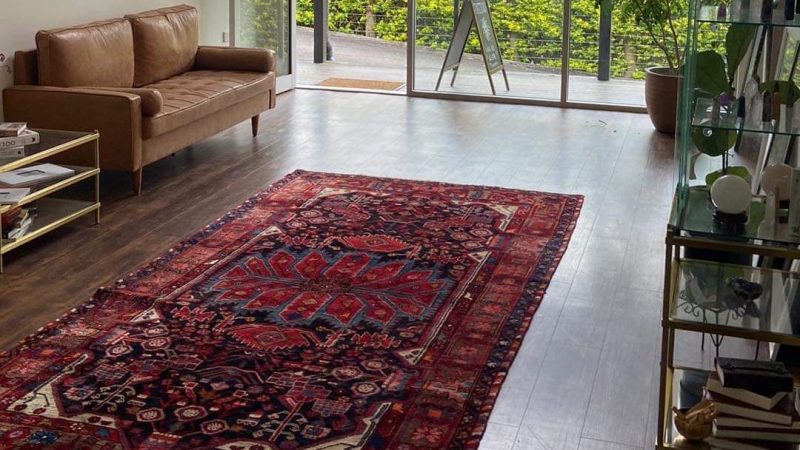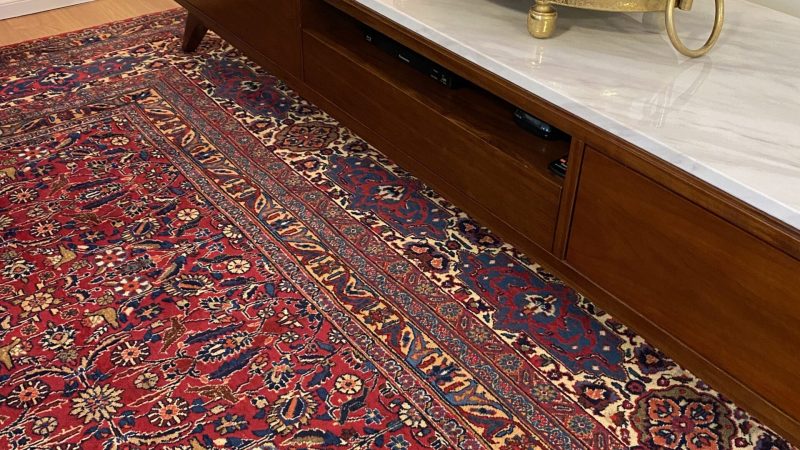
Persian Rug Patterns: What You’re Actually Looking At
Most people looking at a Persian rug for the first time see something beautiful and leave it at that. The patterns look intricate, the colours are striking — but what’s actually going on in the design? Because it’s not random. Each motif in a hand-knotted Persian rug has a name, a region it comes from, and in many cases a meaning that’s been consistent for several hundred years.
This isn’t obscure academic knowledge. It’s the kind of thing that changes how you shop for a rug — and how you talk about the one already on your floor. Knowing a Herati from a boteh, or a city medallion from a tribal geometric, tells you where a rug was made, roughly when, and by whom.
What follows is a plain guide to the main Persian rug patterns — where they come from, what they look like, and what to pay attention to in a hand-knotted piece.
The Medallion — The Pattern Most People Picture
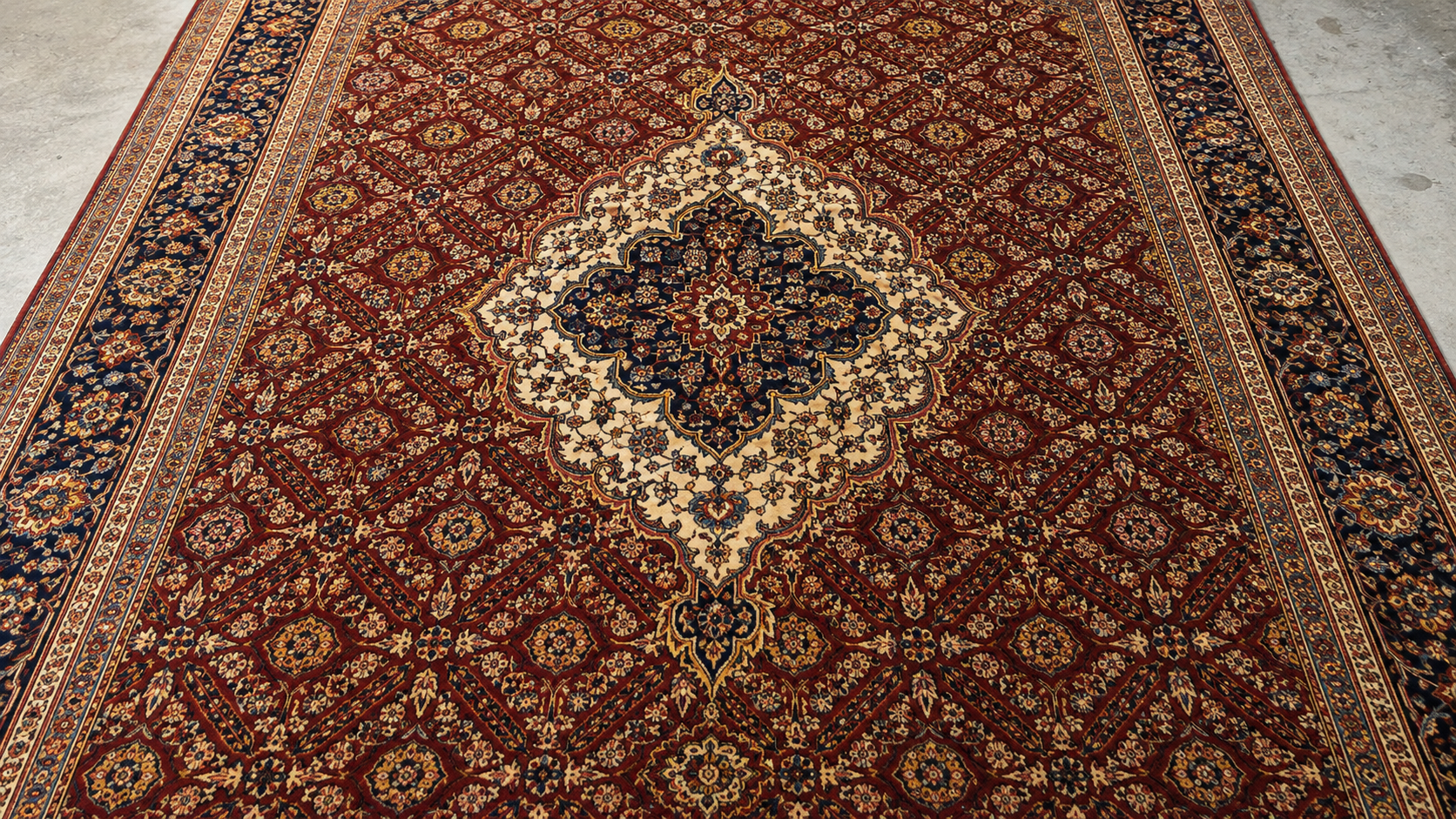
When someone imagines a Persian rug, they’re almost always picturing a medallion. It’s the dominant composition of the great Iranian workshop cities — Kashan, Tabriz, Isfahan — a large symmetrical centrepiece, often shaped like an elongated diamond or sunburst, sitting at the geometric heart of the rug. The four corners usually carry quarter-medallions, mirroring the central piece exactly. Turn the rug 180 degrees and it looks the same.
The medallion didn’t come from nomadic weaving. It came from paper. City workshops employed designers who drew full-scale cartoons — precise, mirrored blueprints — that weavers then translated knot by knot. That’s why medallion rugs have such strict symmetry: the whole design had to exist on paper before the first row was knotted. A tribal weaver working from memory couldn’t produce one, and didn’t try.
When you’re looking at a medallion rug, check three things. The corner pieces should be true quarter-reflections of the centre — not approximate, not slightly off. The border should be proportional, running roughly 15–20% of the total width on each side. And the symmetry, while nearly perfect, should have tiny hand-knotted irregularities — if it’s machine-perfect, it was machine-made. Our Kashan rugs collection has some of the strongest medallion examples we stock.
The Herati — Iran’s Most-Used Pattern
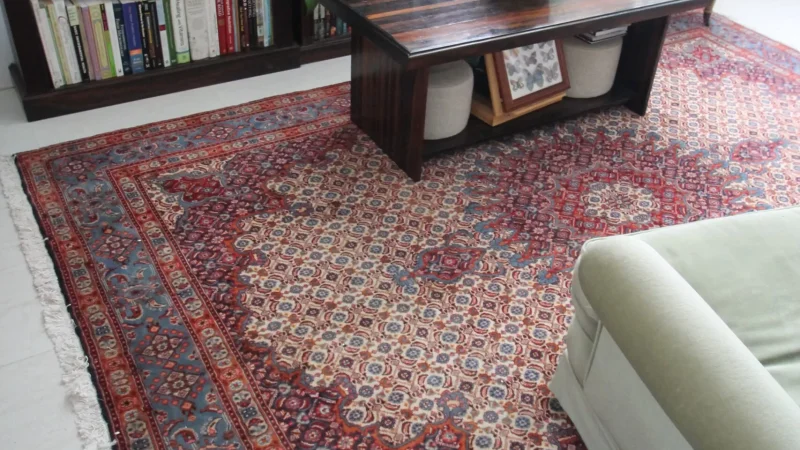
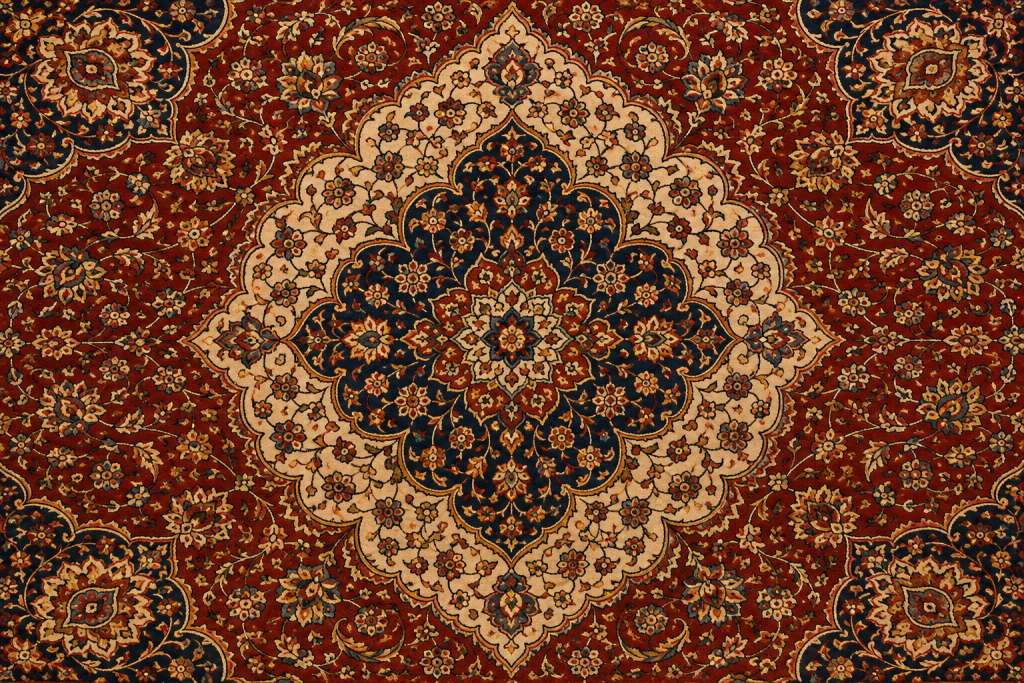
If the medallion is the most iconic Persian rug design, the Herati is the most common. It tiles across the entire field of a rug — sometimes as the main composition, sometimes filling the spaces between a medallion and its border. The core unit is simple: a flower head (rosette) sitting inside a diamond frame, with curved lancet leaves — called mahi, “fish” in Farsi — arching around the outside. That unit repeats, in every direction, thousands of times.
The name comes from Herat, the city now in northwestern Afghanistan that was once one of the great Persian cultural centres. By the 16th century the pattern had spread across Iran — Tabriz, Heriz, Kashan — and it’s been in continuous production ever since. It’s one of those designs that’s simple enough to teach but hard enough to execute well that it still separates good weavers from great ones.
The honest limitation of the Herati: because it’s so common, it appears on rugs across every quality tier — from genuine antiques to cheap machine-made reproductions that copy the pattern without the knot density. The way to tell the difference is to look at the edge. In a well-made hand-knotted Herati, the repeat balances precisely at the border — no motif gets awkwardly cropped. In low-quality work, the pattern just stops wherever the rug ends.
Our Tabriz collection shows the Herati at its best — woven at around 100 to 150 knots per square centimetre, which is where the detail of the fish leaves really becomes visible.
The Boteh — The Shape That Became Paisley
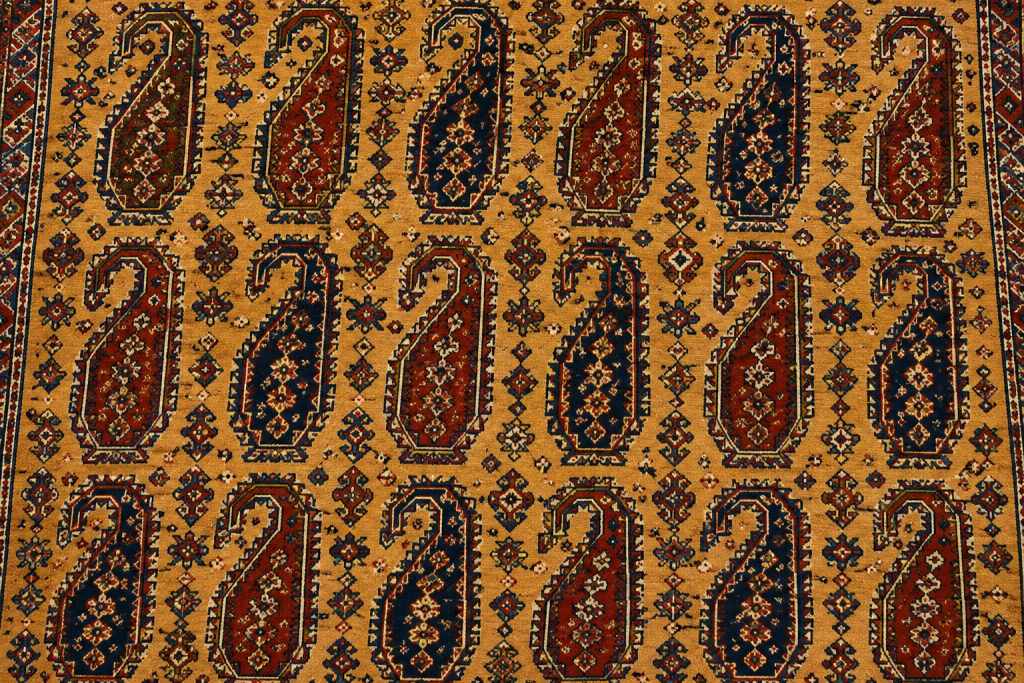
The boteh is a teardrop with a bent tip. That’s the whole shape. But it’s one of the oldest motifs in Iranian textile history — older than the medallion, older than the Herati — and it spread from Persian rug weaving into Indian block printing and then into 19th-century Scottish textile mills, where it became the pattern the West eventually called paisley.
What the boteh actually represents is genuinely unresolved. A cypress tree in wind. A river bend. A flame. A Zoroastrian fire symbol. The fact that no one can agree probably explains why it has lasted — it’s abstract enough that every weaving culture that adopted it could project its own meaning onto it. Qashqai tribal weavers make loose, asymmetrical boteh rugs where the shape shifts from row to row. City weavers produce tighter, more uniform versions. They’re both called boteh and they look almost nothing alike.
Browse our Qashqai tribal rugs to see what the boteh looks like when a weaver is working from memory and intuition rather than a paper design — the colour shifts, the slight irregularities in scale, the natural dye variation. That’s the version worth looking for.
The Garden Rug — A Map of Paradise
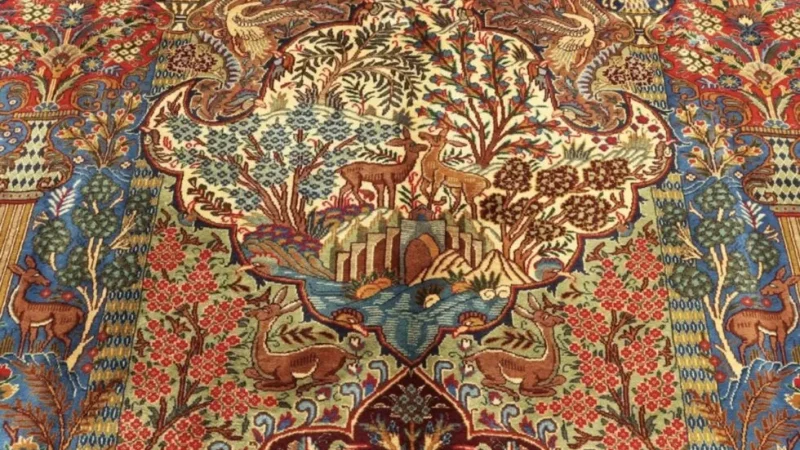
The garden design — chahar bagh, “four gardens” — is the most literal of all Persian rug patterns. It’s a bird’s-eye view of a formal Persian garden: the composition divides into four quadrants by water channels, with flowering trees, birds, fish ponds, and blossoming plants filling each section. You’re not looking at an abstraction. You’re looking at a garden, from above.
The pattern is associated with the Safavid period — roughly 1501 to 1736 — when Isfahan was the capital of a Persian empire wealthy enough to build the gardens it was mapping. The word “paradise” itself comes from the Old Persian pairidaēza, meaning walled garden. These rugs were attempts to bring that ideal inside, to put paradise on the floor.
Genuine antique garden rugs are rare and expensive — anything pre-1900 in good condition will command serious money at auction. But the pattern has continued, and there are well-made 20th-century examples that capture the same compositional logic without the antique premium. The Masterpiece Collection includes pieces where the garden format is still visible in the quadrant structure, even in rugs that have been in use for decades.
Geometric Persian Rugs — No Paper, No Designer
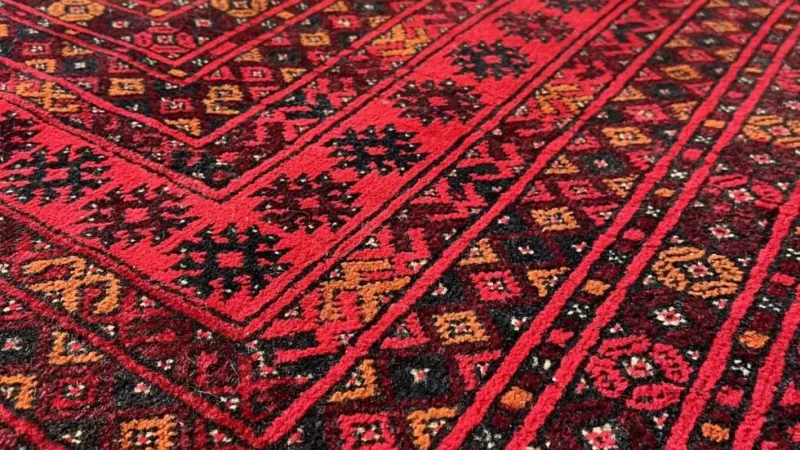
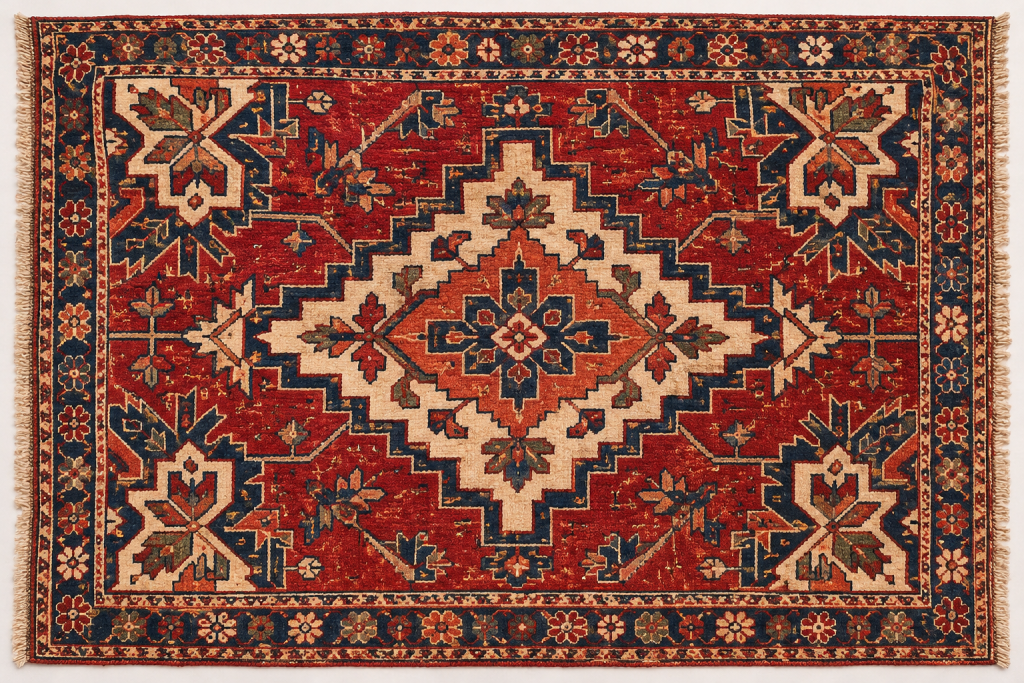
Not every Persian rug has flowing floral curves. The geometric tradition — angular stars, stepped diamonds, interlocking hexagons — is older than the city workshop medallion, and it comes from a completely different weaving context. Nomadic and village weavers didn’t have design studios. They worked from counting sequences passed down through generations, or from memory. The loom itself shapes what’s possible, and on a vertical loom working in wool, the diagonal line is naturally stepped — not curved. That’s where the geometric vocabulary comes from.
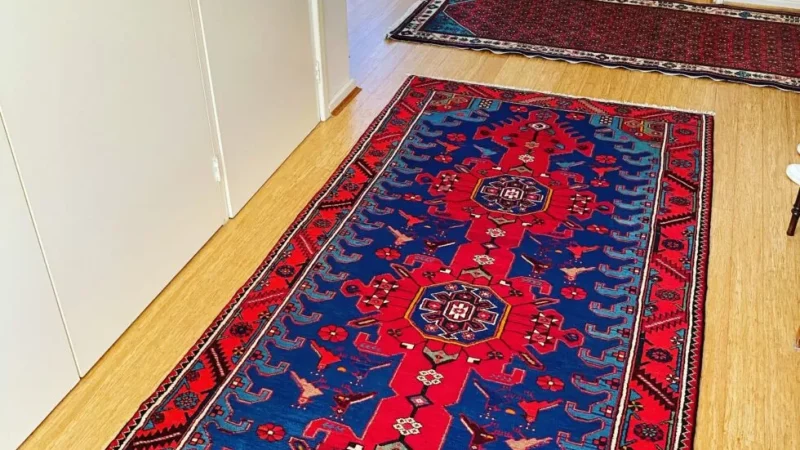
The Heriz is the best-known geometric Persian rug in Western markets. Bold, rectilinear medallions in strong reds and blues, woven in the northwest of Iran from hand-spun wool — the hand-spun gives it a slightly irregular texture that machine-spun wool never replicates. A good Heriz from the mid-20th century will outlast almost any other rug in heavy use. The Gabbeh is the other end of the spectrum: stripped back almost to pure colour and shape, made by Qashqai weavers primarily for their own floors — a domestic object first, an export commodity much later.
Geometric rugs are worth considering if floral patterns feel fussy in your space. They read cleanly against modern furniture and don’t compete with patterned upholstery. See our Heriz rug collection — these are rugs built for use, not just display.
How to Identify a Persian Rug Pattern
Start with the field — the main body of the rug, inside the border. One large centrepiece means medallion. A repeating unit covering the whole surface means Herati, boteh, or geometric. A pictorial scene with figures, animals, or garden quadrants is a pictorial or garden rug. That’s the first cut.
Then look at the border. Persian rug borders are almost always three bands: a wide main border with the primary motif, flanked by two narrow guard stripes. The main border motif often signals the weaving origin — a “turtle” border points to Tabriz, a “cartouche” border to Isfahan. A rug with no real border, or just a thin stripe at the edge, is almost certainly a tribal piece made for use rather than the market.
Turn the rug over. This is the most reliable test. In a hand-knotted Persian rug, the design shows on the back almost as clearly as the front — each knot’s colour is individually visible and you can count them. A tufted or machine-woven rug has a uniform grid of loops on the back, or a canvas backing that hides the construction entirely. The front can be deceiving. The back doesn’t lie.
Frequently Asked Questions
What is the most common pattern on a Persian rug?
The Herati. It appears on more Persian rugs than any other pattern — a repeating rosette-in-diamond with curved lancet “fish” leaves tiling across the whole field. You’ll find it on rugs from Tabriz, Heriz, Kashan, and dozens of other centres, in everything from antique pieces to 20th-century production rugs. Its presence alone doesn’t tell you much about quality; the execution does.
What does a medallion Persian rug represent?
The medallion composition draws on two sources: the geometric dome of Iranian mosque architecture, and the formal Persian garden seen from above. City workshop designers in Kashan and Isfahan adapted both into a single rug format — a large symmetrical centrepiece with four matching corner pieces, designed to anchor a room visually the way a dome anchors a building. It’s a city design, made in workshops with paper cartoons, not a nomadic one.
What is the boteh pattern and where does it come from?
The boteh is a bent teardrop shape — the ancestor of the Western paisley motif. It predates the medallion in Iranian textile history and comes primarily from nomadic weaving traditions, particularly Qashqai and other tribal groups who wove the shape from memory rather than a drawn design. What it represents is genuinely debated: a cypress in wind, a Zoroastrian flame, a river bend. No single explanation has stuck.
How do I tell a hand-knotted Persian rug from a machine-made one?
Turn it over. A hand-knotted rug shows the design on the back almost as clearly as the front — each individual knot’s colour is visible. A machine-made rug has a uniform grid of loops on the back, or a canvas backing. On the front, hand-knotted rugs also show very minor irregularities in line work — slight wobbles that come from the natural variation of hand weaving. Perfect regularity usually means machine production.
What Persian rug pattern works in a modern or minimalist interior?
Geometric patterns — Heriz, Gabbeh, tribal diamond compositions — tend to read more clearly in contemporary spaces because their bold angular lines don’t compete with modern furniture. Medallion rugs also work well when the colour palette is relatively muted. The practical rule: a strongly patterned rug anchors a room with simple furniture; a quieter rug lets complex furniture breathe. Either can work, but pick one — not both.
What makes a Nain rug different from other Persian rugs?
Nain rugs are made in a small city in central Iran and are known for very high knot counts — sometimes above 200 knots per square centimetre — and a distinctive pale palette of ivory, blue, and gold. The designs are almost always formal medallion-and-field compositions drawn from classical Safavid-era patterns, with arabesque scrollwork and Shah Abbasi flower heads. At that knot density, the design reads almost like printing. It’s technically demanding work, and the price reflects it.
Can I try a Persian rug in my home before I buy?
Yes — RugMaster offers an In-Home Trial service within Greater Sydney (within 50km of Sydney CBD). We bring selected rugs to your home so you can see how the pattern and colour read in your actual light and against your furniture before committing. No charge if the rug doesn’t work. Contact us to arrange a time.
Find the Pattern That Fits Your Room
Whether you’re after a Kashan medallion, a Qashqai boteh, or a Heriz that can take decades of foot traffic, every rug in our collection is hand-knotted in Iran and imported directly. If you want to see how a specific pattern reads in your space before buying, our In-Home Trial service brings the rug to you — available within Greater Sydney.
Complete Persian Rug Guide · Kashan Rugs · Heriz Rugs · Qashqai Rugs